Electricity charges and fees explained
Your Electricity Facts Label breaks down the charges that contribute to the cost of your electricity plan. Understanding these charges can help you compare plans beyond the average price per kWh.
Energy charges and base fees
Electricity plans may include different types of charges from your retail electricity provider:
Energy charge: The amount your electricity provider charges for each kilowatt-hour (kWh) of electricity you use.
Base charge: A fixed monthly fee charged by your electricity provider, if applicable.
Usage-based charges: Additional charges that may apply or vary depending on how much electricity you use during a billing cycle.
Some electricity plans also use tiered pricing, where the energy charge changes based on your monthly electricity usage.
See examples: Review these EFLs for the Reliant Free Overnight 12 Plan (base charge), Reliant Secure Advantage® 12 Plan (usage charge) and Reliant Get More, Save More 36 Plan (tiered energy charges) to see how different pricing structures appear on an EFL.
TDSP delivery charges
Transmission and Distribution Service Provider (TDSP) charges cover the cost of delivering electricity to your home through the local power grid, including maintaining poles, wires and other electrical equipment.
Your EFL may include:
These charges are set by your local delivery utility and approved by the Public Utility Commission of Texas (PUCT).
See examples: Review the Reliant Free Overnight 12 Plan EFL to see how TDSP delivery charges are listed.
Bill credits and usage requirements
Some electricity plans offer bill credits when you meet specific usage requirements during a billing cycle. These credits can help lower your electricity bill when your monthly usage reaches a qualifying threshold.
For example, the Reliant Power Savings 2,000 kWh 12 Plan EFL shows how a bill credit applies when monthly electricity usage reaches 2,000 kWh.
When reviewing an EFL, check:
Whether the plan offers a bill credit.
How much electricity you must use to qualify.
How the credit affects your total electricity cost.
Pro tip: Review your electricity usage over the past 12 months to see how often you meet the qualifying threshold. A plan with a bill credit may be a good fit if your household regularly meets the usage requirement.
Solar buyback credits
If you have rooftop solar panels, some electricity plans offer solar buyback credits for eligible excess electricity your system sends back to the grid.
For example, the Reliant Solar Payback Plus 12 Plan EFL shows how solar buyback credits are calculated for excess electricity exported to the grid.
When reviewing a solar buyback plan's EFL, check:
How much credit you can earn per kWh of eligible excess electricity.
Whether credits can offset energy charges, delivery charges or other fees.
Any additional requirements or limitations on earning and using credits.
Pro tip: Consider how much excess electricity your solar panels typically generate and export to the grid when comparing solar buyback plans.
Time-of-use electricity charges
Some fixed-rate electricity plans offer different energy charges depending on when you use electricity.
These time-of-use (TOU) plans may include benefits such as free electricity during certain nights, weekends or other designated periods.
When reviewing a TOU plan's EFL, look for the energy charges that apply during different time periods and any conditions associated with the plan's free electricity hours.
See example: Review the Reliant Free Overnight 12 Plan EFL to see how electricity charges are listed for different times of day.
Pro tip: Consider when your household uses the most electricity to determine whether a time-of-use plan fits your routine.
See how electricity charges appear on a Reliant EFL
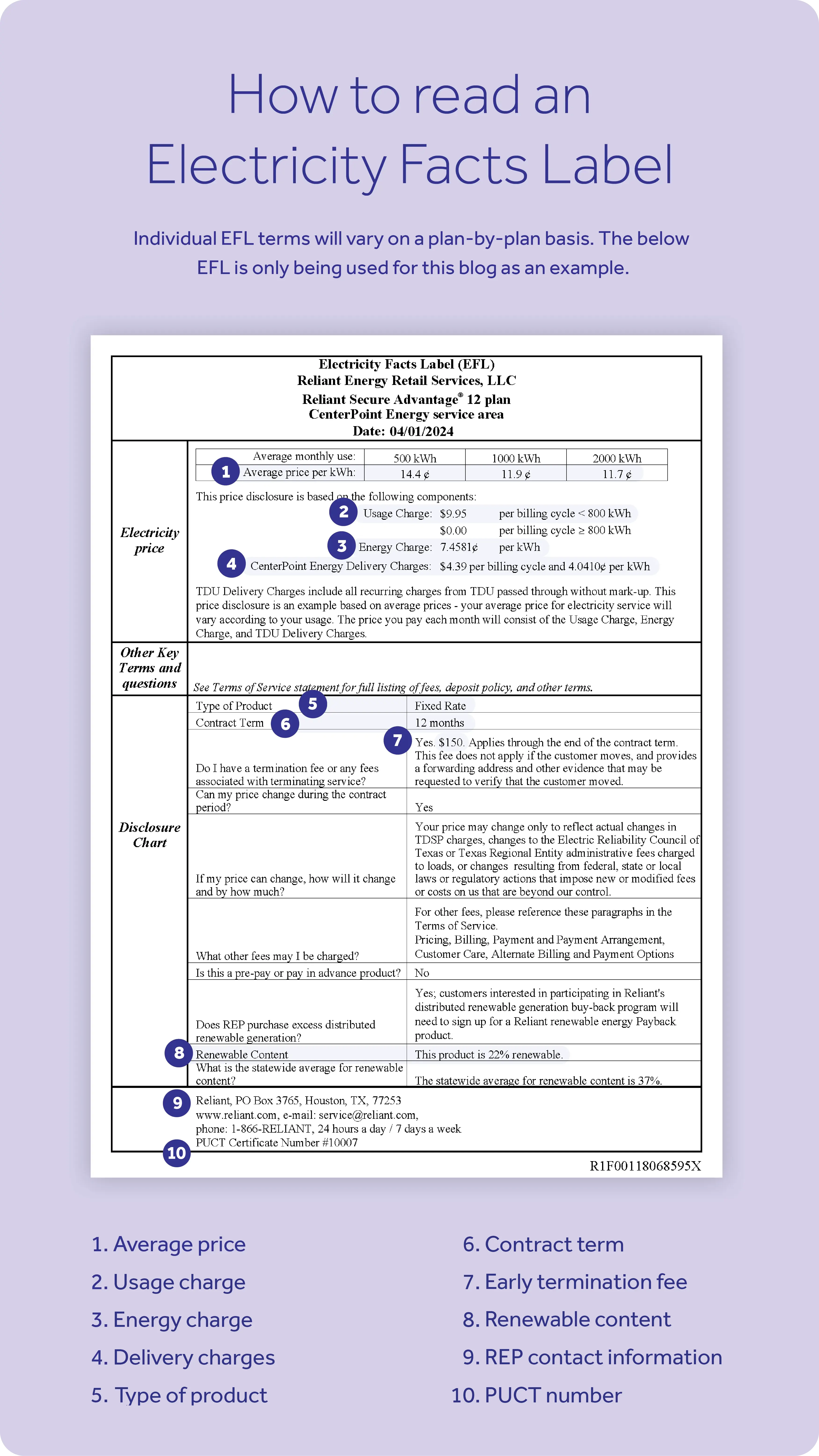
Let's look at the electricity charges listed on our example Reliant Secure Advantage® 12 Plan EFL.
Section 2: Usage charge
This means the monthly usage charge depends on how much electricity you use during the billing cycle.
Section 3: Energy charge
This is the energy charge applied to the electricity you consume.
Section 4: TDSP delivery charges
These charges cover the cost of delivering electricity to your home through the local power grid.
Together, the applicable energy charges, usage charges and TDSP delivery charges contribute to the average price per kWh shown on the EFL.
This price disclosure is an example based on average prices. The average price for electricity service will vary according to your usage. Such charges are not a part of all Reliant plans, so you must read this section of any plan’s EFL that you're interested in.