
How to stop cooling empty rooms and lower your energy bill
Cooling empty rooms can quietly add to your energy bill. Learn why closing vents may not be the answer and how smart thermostats and occupancy-based automation can help reduce wasted heating and cooling without sacrificing comfort.
How to stop cooling empty rooms and lower your energy bill
Cooling empty rooms can quietly add to your energy bill. Learn why closing vents may not be the answer and how smart thermostats and occupancy-based automation can help reduce wasted heating and cooling without sacrificing comfort.
Most central heating and cooling systems treat the home as a single zone. A thermostat reads the temperature in one location and controls heating or cooling for the whole house, whether every room is occupied or not.
ENERGY STAR says that heating and cooling make up almost half of the average home’s annual energy bill, working out to over $1,000 a year.1 That’s a big enough chunk of your budget to warrant digging a little deeper into where potential energy waste is creeping in.
Before we jump into fixes, it helps to understand why an unused room drains energy in the first place. It all comes down to how most HVAC systems are built.
A typical home runs on a single thermostat that reads one spot and sets the temperature for the whole house. Your system doesn’t know the difference between a bedroom you sleep in every night and a guest room that’s only occupied once or twice a year. It simply keeps every room at the same setting.
Bigger homes may have more opportunities for savings when unused spaces are being cooled or warmed every day. Whether it’s a home office you use only a few days a week, a nursery turned storage room or a bedroom that sits empty most of the time, your system is still conditioning that space. A few rarely-used rooms can increase your cooling load, and tackling the problem can add to meaningful savings.
For most homes with central HVAC, closing vents is usually not the best way to save energy.
Closing vents in unused rooms can help save energy in certain circumstances, but it is not a one-size-fits-all fix. For most centrally ducted systems, closing a vent doesn’t reduce how much air your system produces. Your heating or cooling system is sized to move a set volume of air through the whole house, and that doesn’t change just because a register is shut. The air has to go somewhere, so it gets pushed through the vents that are still open, or it finds its way out through gaps in the ductwork.
Duct systems are designed to move air in a careful balance between supply and return, and blocking that airflow, whether from closed vents, furniture or limited return air capacity, can affect system performance. When too many vents close at once, air pressure can build up in the ductwork. That extra pressure can force more conditioned air out through existing duct leaks, making your blower work harder just to move the same amount of air. Because every HVAC setup is different, it’s best to avoid closing multiple vents unless a technician has confirmed your system can handle it.
If you want a low-effort option, simply closing the door to a rarely used room while leaving its vent open may be a better alternative. It won’t stop the room from being conditioned, but it can limit how much cooled or heated air drifts into hallways and other spaces. Even this approach only goes so far: A closed door can restrict return airflow in some layouts, and it does nothing to adjust automatically if your schedule changes. That’s the real limit of a manual fix. You have to remember to do it every day, in every season.
If manual habits are unreliable at best, the next step is a system that makes adjustments on its own, without you having to think about which rooms are currently in or out of use.
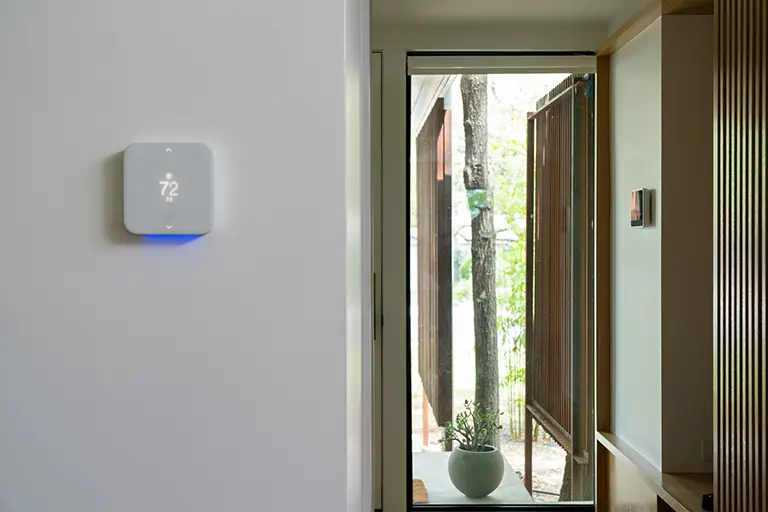
A Wi-Fi-enabled smart thermostat can use sensors, scheduling and geofencing to help determine when your home is unoccupied and adjust the temperature accordingly. Instead of guessing, the system responds to actual patterns in how you live, and it does it automatically, without you needing to oversee or manage the process.
The Comfort IQ™ bundle from Reliant helps reduce wasted heating and cooling by letting your home respond when people are home, away or moving through their day. The bundle includes a fixed-rate electricity plan from Reliant, a Vivint Smart Thermostat and in-home sensors that use the Vivint Smart Comfort feature to detect when your home is occupied or empty. When no one’s around, the thermostat can adjust on its own to help cut down on wasted cooling or heating, and you can always override adjustments for comfort.
Because the Comfort IQ bundle technology runs in the background, there’s nothing to remember and nothing to reset when your routine shifts. That’s the main advantage over manual habits like closing vents or shutting doors. The bundle also includes free professional installation from Vivint, so you’re not left guessing about sensor placement.
Everyone wants to know the magic number, but in reality, there isn’t one. Your actual savings will vary depending on your specific home.
How much you save on your heating and cooling costs is likely to fluctuate based on the following factors:
As a general benchmark, ENERGY STAR estimates that smart thermostats save the average household somewhere between $50 and $100 a year on heating and cooling.2 Any savings figure, including any from Reliant, is an estimate rather than a guarantee, since results vary from house to house.
The Comfort IQ bundle goes beyond occupancy-based adjustments by including participation in Reliant’s Degrees of Difference Smart Thermostat Program. During certain times, such as when high electricity demand is anticipated, the Vivint Smart Thermostat may automatically adjust by up to 4 degrees to help reduce energy use.
You will receive notifications before and during these events and can opt out of individual events by manually adjusting your thermostat. You may earn a $40 annual bill credit by participating in at least 50% of eligible Degrees of Difference event hours during a program year. Additional estimated energy savings may come from use of the Vivint Smart Comfort feature, though actual results vary based on individual circumstances.
Closing vents may feel like an easy fix, but occupancy-based automation can help address wasted heating and cooling without adding another task to your routine. See how the Comfort IQ bundle combines smart home technology and energy management to help your home respond more efficiently when you’re home or away.
Select a category from the drop-down menu.


