How smart thermostats save energy
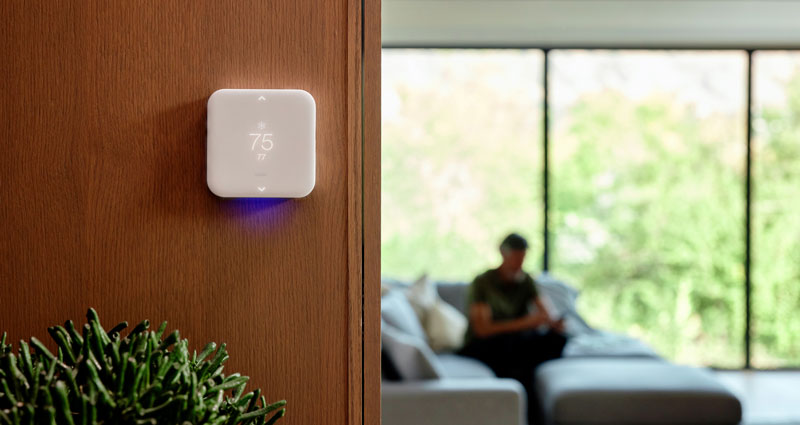
A smart thermostat doesn’t heat or cool your home more efficiently than a standard one. Your furnace and air conditioner do the same amount of work either way. The savings come in when you run the equipment less, specifically during the hours when no one is home to benefit from it. Every minute your HVAC system isn’t heating or cooling an empty space is a minute you aren’t paying for. How does it work?
Occupancy detection and geofencing
Most smart thermostats use built-in sensors or your phone’s location to figure out when your home is empty. Geofencing tracks when you leave a set radius around your house and shifts the temperature to an energy-saving setting, then adjusts back before you’re expected home. Some models add motion or door and window sensors to catch activity room by room, which helps in situations a phone’s location alone would miss, like someone working from a home office all day.
Routine learning and remote control
Many smart thermostats also build a schedule from your actual habits using learning algorithms, instead of requiring you to program one by hand. That distinction matters quite a bit. Back in 2009, the EPA suspended ENERGY STAR certification for programmable thermostats, in large part because most people never set a schedule on them, so the devices delivered little of their theoretical savings.
However, in 2017, the EPA introduced new standards for Wi-Fi-enabled smart devices, and ENERGY STAR certification for smart thermostats was once again available. Why? Because newer technology and Internet connectivity meant that the thermostat could learn a user’s routine more accurately in real time. Remote access through a phone app closed another gap: if plans change, you can adjust the temperature from anywhere instead of paying to cool an empty house until you get home.
If you’d rather set your own schedule than rely on automation, setting your thermostat efficiently may still deliver some savings without needing a smart device. However, automation ensures that forgetting to make manual updates won’t show up as sticker shock on your next utility bill. For a broader look at what else can be automated around your house to increase savings, see our guide to smart home energy devices.