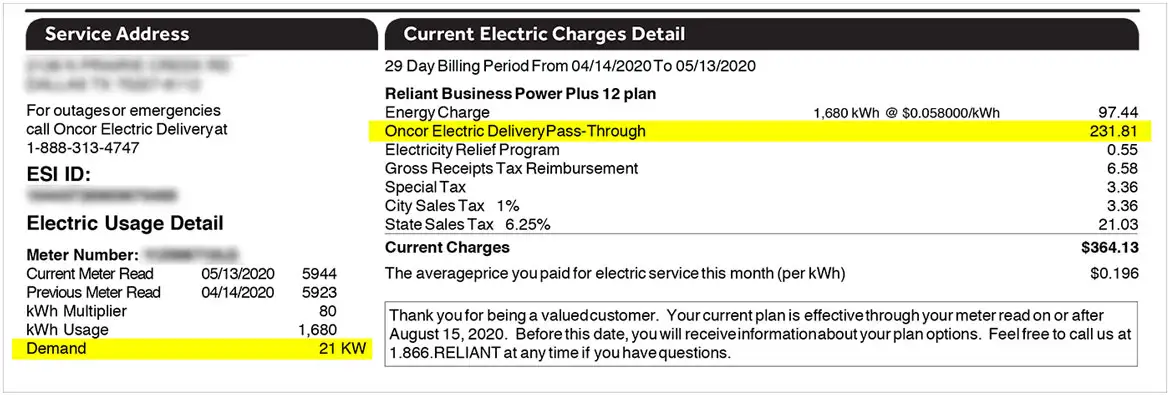
Understanding your business energy bill
On your bill, the demand charge is typically part of your Transmission and Distribution Service Provider (TDSP) charges. Your bill will also show your peak demand for the billing period.
Demand: This represents the highest rate of power your business used in any single, short interval (commonly 15 minutes) during the billing cycle.
- kW (kilowatt): This is the unit of real power, the actual power your equipment uses to do work.
- kVA (kilovolt-ampere): This is the unit of apparent power, which includes both real and reactive power, representing the total electrical load on the grid. Utilities often use kVA for larger commercial customers.
How electricity demand charges are calculated
Calculating your demand charge is straightforward:
- Identify your peak demand: Your utility identifies the highest point (your peak demand in kW or kVA) where your business consumed electricity fastest during the billing month
- Apply the rate: They then multiply this peak demand by their specific demand charge rate (a set price per kW or kVA)
- Multiply: Your highest "speed" (peak demand) x the price per kW (or kVA) = your demand charge